

Medical Billing Process decisions quietly determine whether your practice grows, stalls, or slowly bleeds cash. In 2025, every registration, every ICD-10 code, every modifier, and every denial follow-up is part of an invisible system that either supports your clinical work, or sabotages it one claim at a time.
Let’s be honest. The Medical Billing Process is no longer “just sending claims to insurance.” It is a high-stakes chain of eligibility checks, prior authorizations, coding logic, claim scrubbing, payer edits, denial management, and patient collections. One missed step can trigger delayed payments, lost revenue, or compliance exposure. According to the Centers for Medicare & Medicaid Services, improper payments in Medicare fee-for-service still cost the system billions every year, largely driven by documentation gaps, coding errors, and coverage-rule failures.
At the same time, federal watchdogs such as the Office of Inspector General no longer wait for obvious fraud. They hunt for patterns: repeated coding errors, weak documentation, and practices that fail to meet coverage criteria. Professional guidance from organizations like the AMA and clinical insights from trusted resources such as the Cleveland Clinic and National Institutes of Health set a high bar for medical necessity, disease specificity, and evidence-based care. If your Medical Billing Process cannot reflect that rigor, payers will eventually notice.
So the real question is not, “What is the medical billing workflow?” but “How disciplined is your Medical Billing Process under 2025 rules?” Do your front-desk teams verify eligibility every time? Do your coders apply ICD-10 and CPT logic confidently? Does your billing staff run a structured denial process or simply fight isolated fires? In a world where a large share of medical bills contain at least one error, the process is no longer an operational choice; it is a survival strategy.
Whether you run a solo practice or a multi-site specialty group, your Medical Billing Process is your real business model. It is the engine that transforms clinical encounters into sustainable revenue. That is why providers increasingly rely on specialized partners likeCareCloud Medical Billing, whose medical billing solutions are built to simplify the revenue cycle and strengthen financial performance.
In this 2025 guide, you will see how the Medical Billing Process truly works, step by step. You will learn how ICD-10 and CPT codes shape payment, how documentation should be structured to survive audits, how denial management can evolve from chaos to intelligence, and how CareCloud Medical Billing turns scattered tasks into one controlled revenue cycle.
Key Takeaway: In 2025, the Medical Billing Process is no longer a back-office task, it is a compliance system, revenue engine, and risk filter. Practices that automate eligibility verification, strengthen documentation, apply accurate coding, and run structured denial management outperform those that rely on manual billing. A modern billing partner like CareCloud Medical Billing helps physician groups protect revenue, reduce denials, and stay audit-ready in an increasingly complex healthcare payment environment.
Medical Billing Process in 2025 and Why Has It Changed?
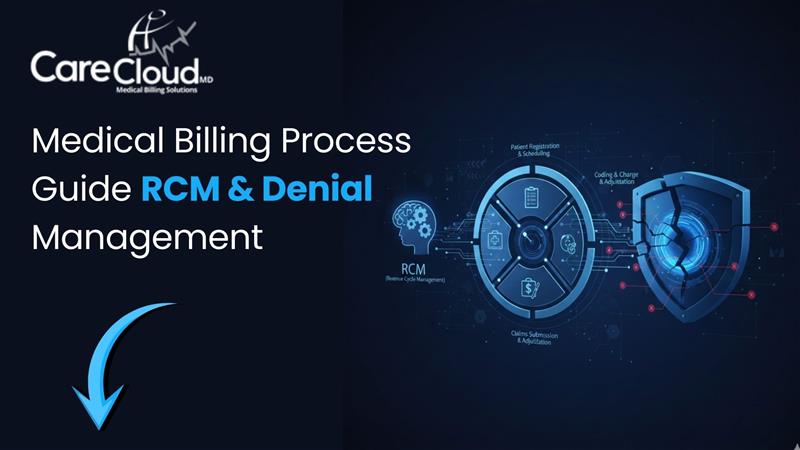
The Medical Billing Process is the system that turns care into cashflow. In 2025, it is not a back-office chore, it is business infrastructure. From the moment a patient schedules to the moment the last dollar posts, your revenue moves through one tightly-coupled sequence: registration, coding, claim submission, adjudication, and collections.
Why did it change? Because payers changed.
Adjudication is faster. Edits are automated. Documentation is machine-read before people read it. Denial trends are tracked across networks, not single clinics. A modern Medical Billing Process must therefore act like a living system, not a static checklist.
If your revenue cycle still feels reactive, it’s because your workflows were built for another era. In 2025, successful practices treat billing as strategy, an operating system that blends people, protocols, and technology.
How Does the Medical Billing Process Work in 2025?
Break the Medical Billing Process into three zones: front-end, mid-cycle, back-end. Each zone carries different risks, and different profit potential.
- Front-end work decides if a claim is even viable.
- Mid-cycle work decides if it is defensible.
- Back-end work decides if it is collectible.
Here is the operating map your team should be using in 2025:
| RCM Stage | Core Activities in the Medical Billing Process | High-Risk Failure Point |
| Front-End Registration | Patient registration, demographic capture, insurance and benefits checks, financial policy explanation | Incomplete data, weak eligibility verification process, missing referrals or PA |
| Mid-Cycle Coding & Charge Capture | Clinical documentation review, ICD-10 diagnosis coding, CPT/HCPCS procedure coding, charge entry and validation | Under-coding, over-coding, missed charges, mismatched ICD–CPT pairs |
| Back-End Claims & Collections | Claim scrubbing, claim submission process, payer edits, denial management, payment posting, patient billing | Timely filing failures, no root-cause denial analysis, weak follow-up on underpayments |
This flow reflects best practice RCM steps described in CareCloud’s own revenue cycle improvement strategies, front-end verification, mid-cycle documentation and coding accuracy, and back-end denial management and collections.
How Do ICD-10 and CPT Codes Drive the Medical Billing Process in 2025?
Underneath every claim, the Medical Billing Process is powered by ICD-10 and CPT. ICD-10 codes explain why care was delivered; CPT and HCPCS codes describe what was done. Payers evaluate the relationship between these codes to determine coverage, medical necessity, and payment level.
In 2025, coding is no longer just a back-office activity. It is a central lever in the Medical Billing Process. Diagnosis codes must carry appropriate specificity, chronic conditions must be accurately captured, and CPT codes must reflect either time, medical-decision complexity, or defined procedural rules. When any of these elements are vague, payers underpay, deny, or flag providers for review.
That is why services like CareCloud MD’s Medical Billing and Coding Services place such emphasis on coder training, specialty-specific rules, and regular auditing. For complex specialties, coders must understand not only the code sets but also the clinical logic behind them.
DID YOU KNOW?
A significant share of denials in many practices still comes from simple ICD-10–CPT mismatches and insufficient specificity, a problem repeatedly highlighted in payer guidance and coding reviews published by the Centers for Medicare & Medicaid Services, in their medical review and improper payment audits.
When coding is approached strategically, the Medical Billing Process becomes more predictable. Claims pass payer edits more consistently, revenue forecasting improves, and providers gain more confidence in the financial impact of their clinical decisions.
Which CPT-Based Services Require the Strongest Medical Billing Process in 2025?
Not every service is equally sensitive to errors. Routine low-level visits may tolerate minor inconsistencies. High-value, high-scrutiny services do not. In 2025, certain CPT categories demand a more disciplined Medical Billing Process than ever.
Examples include prolonged or high-level office visits, telehealth and virtual care encounters, chronic care management, behavioral health sessions, diagnostic imaging, and surgical procedures that require prior authorizations and strict medical-necessity documentation.
To visualize this, consider the following block.
CPT Services and Process Dependence
| Service Category | Common CPT Examples | Why the Medical Billing Process Must Be Strong |
| Office & Telehealth E/M | 99213–99215, 99203–99205, telehealth codes | Level selection, time vs. MDM logic, telehealth modifiers, and POS must align |
| Chronic Care & Remote Monitoring | 99490, 99439, 99457, 99458 | Service time, continuity of care, and monthly documentation must be precise |
| Behavioral Health & Counseling | 90791, 90832–90837, 96127 | Session length, modality, and goals must match the code and payer policies |
| Surgical & ASC Procedures | Procedure-specific CPT ranges | Prior auth, facility vs. professional billing, and global periods must be clear |
Specialties that rely heavily on such services often benefit from a partner who understands both clinical nuance and payer behavior. This is why clinics using CareCloud Medical Billing Specialties portfolio see the Medical Billing Process adapted to each specialty instead of being forced into a generic template.
What Treatments Depend on a Clean Medical Billing Process in 2025?
Behind every code in the Medical Billing Process, there is a real person managing a real condition. Chronic disease management, preventive screenings, post-operative follow-ups, mental health support, and telehealth-enabled continuity of care all generate a series of encounters that must be properly documented and billed.
In 2025, treatments for complex, multi-morbid patients often involve multiple providers, multiple sites, and multiple payers. That means the Medical Billing Process must keep up with:
Ongoing changes in coverage for chronic care management or remote monitoring.
Updated preventive-care guidelines that affect what screenings are covered.
Evolving telehealth rules that influence where and how services can be billed.
CareCloud Medical Billing clients, for example, often combine core billing with services like Physician Credentialing Services and Contact Center & Patient Scheduling Services, so that provider enrollment, scheduling, and clinical workflows support, not obstruct, the Medical Billing Process. When the operational and clinical sides are aligned, treatments are easier to sustain financially.
In short, treatment plans no longer live only in the EHR. They live in the revenue cycle as well, because only a clean Medical Billing Process ensures that medically necessary care also remains financially viable.
How Should Documentation Be Structured in 2025 to Prevent Denials?
Documentation is the spine of the Medical Billing Process. Without it, codes are guesses; with it, they become defensible evidence of medical necessity.
In 2025, payers and regulators expect documentation to show a coherent chain: why the patient presented today, what was found, what risks were considered, which diagnoses were made, and why each procedure or service was reasonable and necessary. When that chain is weak, the claim is weak.
To make this easier, many practices standardize the core layers of documentation into structured templates and checklists.
Documentation Quality in the Medical Billing Process
| Documentation Layer | What It Should Capture in 2025 | Impact on the Medical Billing Process |
| Front-End Patient Record | Accurate demographics, insurance details, policy dates, referral or auth | Reduces eligibility denials and coverage disputes |
| Clinical Encounter Note | History, exam, objective findings, risk factors, tests, and responses | Justifies ICD-10 choice and supports higher-level E/M or procedures |
| Assessment & Plan | Definitive and suspected diagnoses, rationale, treatment and follow-up plan | Demonstrates medical necessity for each billed CPT or HCPCS code |
| Billing & Coding Summary | Final ICD-10 list, CPT/HCPCS codes, modifiers, POS, rendering provider | Connects clinical narrative to the structured data payers adjudicate |
When these layers line up, the Medical Billing Process becomes audit-ready by design. When they do not, billers and coders are forced to “fix” documentation problems after the fact.
DID YOU KNOW?
Even when providers deliver appropriate care, weak documentation alone can trigger medical-necessity denials, downcoding, or repayment demands, a risk repeatedly emphasized in audit findings and compliance bulletins issued by the Office of Inspector General (OIG) in its program integrity and medical review reports.
How Has the Denial Process in Medical Billing Changed in 2025?
Denials used to be treated as unfortunate events at the end of the line. In 2025, the denial process in medical billing is a core intelligence function inside the Medical Billing Process itself.
Modern practices no longer ask, “How do we fix this one denial?” They ask, “What does this category of denials tell us about our system?” Denial management in 2025 is about pattern recognition, root-cause analysis, and strategic correction.
A strong denial strategy tracks each denial by type, payer, reason code, and service line. It identifies whether the failure came from registration, eligibility, prior authorization, documentation, coding, or technical issues such as late filing. Then it pushes corrective actions upstream so that the same pattern does not repeat.
CareCloud MD’s AR & Denial Management Services are built around this philosophy. Instead of only working aging AR as a backlog, they use denials as a radar system that tells you where the Medical Billing Process is leaking revenue.
Denial Management in the Medical Billing Process
| Denial Category | Likely Root-Cause Weakness in the Medical Billing Process | Strategic Fix in 2025 |
| Eligibility and coverage denials | Weak or skipped eligibility verification process at front-end | Deploy real-time checks and train staff on payer-specific rules |
| Medical-necessity denials | Vague ICD-10 codes, insufficient encounter details, missing risk factors | Enhance templates and provider education for documentation specificity |
| Coding and bundling denials | Incorrect CPT selection, missing modifiers, unbundled services | Implement routine coding audits and robust claim-scrubbing rules |
| Timely filing and technical denials | Lack of claim-tracking dashboards and unclear timelines | Use RCM automation and KPIs to monitor deadlines and claim statuses |
When denial data is transformed into intelligence, the Medical Billing Process becomes stronger each month instead of repeating the same mistakes.
Why Choose CareCloud MD for the Medical Billing Process in 2025?
In 2025, billing partners are no longer vendors; they are infrastructure. A fragmented billing setup can undo months of clinical effort. A unified, expert-driven Medical Billing Process can stabilize your entire organization.
CareCloud MD positions itself as a true revenue-cycle partner. Its Revenue Cycle Management Services are designed to manage the full Medical Billing Process, from eligibility verification and prior authorizations to claim submission, AR follow-up, and denial analytics.
For providers who struggle with front-end risk, Verification and Prior Authorization Services reduce preventable denials by ensuring coverage, benefits, and approvals are in place before high-value services are delivered. For complex or multi-site groups, Specialty-specific solutions align billing workflows with the unique rules of each clinical domain, whether that is primary care, surgery, behavioral health, or ambulatory surgery centers.
CareCloud MD also invests heavily in expertise. Its Medical Billing and Coding Services rely on certified coders and experienced billers who understand both payer policy and specialty nuance. Its Blog and resource content guide providers through RCM trends, regulatory changes, and best practices, so leadership teams can make decisions based on more than anecdotes.
Above all, CareCloud MD treats the Medical Billing Process as a strategic asset, not a back-office chore. Workflows are built for clean claims, strong compliance, and predictable cash flow, not for survival.
If you are ready to turn billing from a weak point into a core strength, you can start a conversation through the Let’s Connect page and explore what a modern, 2025-ready RCM partnership looks like.
Medical Billing Process FAQs
- 1. What is the Medical Billing Process?
The Medical Billing Process is how patient visits become payments, covering eligibility checks, coding, claim submission, denials, and collections. Need help streamlining this? Contact CareCloud MD for RCM support.
- 2. What are the main Medical Billing Process steps?
The Medical Billing Process includes front-end registration, mid-cycle coding, and back-end denial management and AR follow-up. CareCloud MD can manage all three stages for you.
- 3. How does denial management fit into the Medical Billing Process?
The Medical Billing Process improves when denials are tracked, analyzed, and prevented, rather than just appealed. Ask CareCloud MD about denial management solutions.
- 4. Why is documentation critical in the Medical Billing Process?
The Medical Billing Process depends on documentation to prove medical necessity and support ICD-10 and CPT coding. CareCloud MD helps standardize documentation workflows.
- 5. How can I improve my Medical Billing Process in 2025?
The Medical Billing Process becomes stronger through automation, real-time eligibility, and professional RCM oversight. Upgrade with CareCloud MD’s RCM solutions.